What Is Corrosion-Resistant Aluminium Chequer Plate
Corrosion-resistant patterned aluminum sheets belong to the core material of 5-series rust-resistant aluminum alloys. They combine advantages such as anti-slip and wear-resistant properties, long-term corrosion resistance, lightweight, and easy processing. They are now widely used as anti-slip load-bearing structural components in ships, with the 5052 and 5083 marine-grade certified alloys accounting for over 80% of the marine patterned aluminum sheet market share.
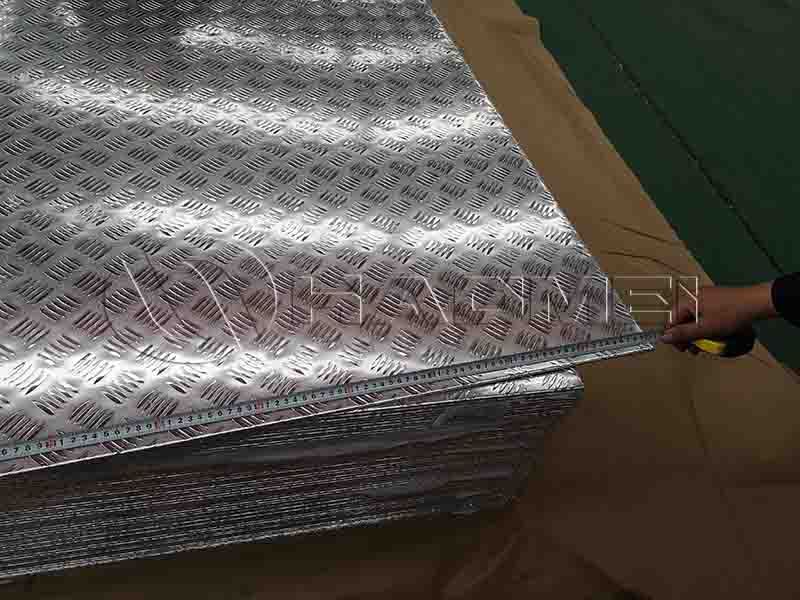
I. Basic Definition of Corrosion-Resistant Aluminum Chequer Sheets
Rust-resistant alloy aluminum sheets use pure aluminum as a base, with the addition of metals such as magnesium, manganese, and chromium through smelting and rolling. The surface is rolled to create raised anti-slip patterns. Common styles include five-rib, lentil-pattern, orange peel, and three-rib patterns. They belong to the 5-series aluminum-magnesium rust-resistant alloys and are clearly distinguishable in performance from 1060 pure aluminum and 6061 structural patterned aluminum sheets.
These types of aluminum plates possess two core characteristics: Firstly, they are inherently corrosion-resistant, requiring no galvanizing or anti-corrosion coatings. The alloy surface spontaneously forms a dense aluminum-magnesium oxide protective film, blocking chloride ions, salt, and moisture from seawater, effectively resisting intergranular and stress corrosion, making them suitable for high-salt marine environments.
Secondly, the integrated anti-slip texture significantly enhances surface friction, reducing the risk of slippage for personnel and equipment due to deck water accumulation, oil stains, and seawater residue, simultaneously ensuring structural durability and operational safety.
II. Performance Comparison of 5052 and 5083 Marine Patterned Aluminum Plates
Both are non-heat-treatable strengthened aluminum-magnesium alloys and are the only patterned aluminum plates certified by classification societies and suitable for marine conditions. The core differences lie in magnesium content, seawater corrosion resistance rating, structural strength, and procurement cost, making them suitable for different positions on a vessel.
1. 5052 Economic Marine Aluminum Plate
The magnesium content of 5052 grade aluminium ranges from 2.2% to 2.8%, supplemented with a trace amount of chromium to strengthen the oxide protective layer, meeting national maritime standards.
The 5052 sheet metal exhibits excellent plasticity, making bending, cutting, and welding relatively easy. It possesses moderate resistance to salt spray and freshwater corrosion, with an average annual seawater corrosion rate of 0.035 mm, exceeding general marine material standards. Its lightweight nature results in low procurement and maintenance costs.
The drawback is its relatively low magnesium content, limiting overall strength and making it unsuitable for prolonged immersion in high-salinity deep-sea water. Its load-bearing capacity is also relatively weak.
2. 5083 High-End Deep-Sea Aluminum Plate
With a magnesium content of 4.0% to 4.9%, combined with manganese and chromium to enhance alloy stability, Al 5083 is a top-tier 5-series corrosion-resistant material for ocean-going vessels. It boasts industry-leading resistance to chloride ion corrosion, allowing for long-term exposure to near-shore and deep-sea high-salinity environments with an average annual corrosion rate of only 0.02 mm.
Its tensile and load-bearing strength far exceeds that of 5052, exhibiting outstanding resistance to wave impact and deformation. It does not become brittle in low-temperature environments, making it suitable for polar vessels navigating at low temperatures. After welding, there is no risk of localized corrosion, and the overall structure remains stable.
The drawbacks are its high material hardness, significant bending springback, higher processing costs for irregularly shaped components, and higher raw material prices.
Quick Selection Reference: For inland waterway vessels and yachts with no load-bearing areas on the upper deck and projects with limited budgets, choose 5052; for ocean-going cargo ships, fishing boats, water-damped load-bearing decks, and offshore operation platforms, prioritize 5083.
III. Detailed Applications Across All Ship Scenarios
Corrosion of marine hulls varies with water level: above the waterline, only salt spray and sea wind erosion occur; corrosion is strongest at the waterline due to alternating wet and dry conditions; underwater, long-term immersion in seawater necessitates matching two different patterned aluminum plates based on corrosion intensity and load-bearing requirements.
Prioritize 5052 for superstructure areas: Suitable for cockpit steps, cabin passageways, stair treads, maintenance platforms, storage room floors, and leisure yacht decks. This area has no heavy load requirements; 5052 is easy to process, allowing for rounded and irregularly shaped edges; anti-slip textures prevent slipping in water; and the lightweight material reduces the load on the upper part of the hull, decreasing fuel consumption.
5083 aluminum checker plate must be used at the waterline junction: Ship hull plating, landing craft platforms, and waterline walkways are subjected to repeated wave erosion. Ordinary alloys are prone to white spots and delamination corrosion, while high-magnesium 5083 can resist alternating wet and dry corrosion, with a service life of over fifteen years, eliminating the need for frequent anti-corrosion coating replacements.
Thickened 5083 aluminum tread plate is used in underwater load-bearing areas: Cargo hold floors, fish hold bulkheads, bottom maintenance ramps, and ballast tank liners are constantly submerged in deep water, simultaneously bearing cargo, equipment, and personnel. This material provides load-bearing capacity, impact resistance, and long-term corrosion protection, replacing traditional stainless aluminum with a 30% weight reduction, thus lowering the ship's draft.
Marine supporting facilities are selected according to needs: Floating platforms, boarding ladders, near-shore floating bridges, and lifeboat floors often use the more cost-effective 5052 aluminum; offshore wind power maintenance vessels, research vessels, and polar operation vessels uniformly use 5083 aluminum for the entire deck to cope with extreme marine climates.
IV. Core Advantages Compared to Traditional Metal Sheets
Firstly, lower corrosion resistance and maintenance costs. 5052 and 5083 aluminum sheets have built-in rust-resistant capabilities, eliminating the need for annual anti-corrosion paint application. Compared to carbon aluminum patterned plates, this reduces maintenance costs by up to 60%.
Secondly, lighter weight improves navigation efficiency. Aluminum's density is only one-third that of aluminum, significantly reducing weight and fuel consumption, meeting the requirements for low-carbon ship construction.
Thirdly, adaptable to various marine environments. The sheet material is non-magnetic, preventing marine organism adhesion, and is resistant to low temperatures and sea winds, making it suitable for navigation in all sea areas.
Fourthly, longer service life. 5052alloy has a normal service life of eight to ten years in near-shore environments, while 5083aluminum can reach fifteen to twenty years in deep-sea conditions, demonstrating durability far superior to ordinary metal patterned plates.
Original Source:https://www.marinealu.com/a/what-is-corrosion-resistant-aluminium-chequer-plate.html
Tags: marine grade aluminum checker plate ,
Prev:Aluminum Friction Stir Welding Sheet
Next:Top 10 Uses of Marine Aluminum Profiles in Boat Building