What Are the Uses of Bulb Plate in Ship
Ball flat aluminum is a specialized aluminum profile with a cross-section resembling a "ball head + flat web," similar to the cross-section of a golf club. Its unique structural design gives it both high strength and excellent weldability.
Combined with the inherent lightweight and corrosion resistance of aluminum, it has become a core material for reinforcing ship hull structures, widely used in the construction of various civilian and military vessels, and even large warships and aircraft carriers. Its specific applications are mainly concentrated in the following three core areas:
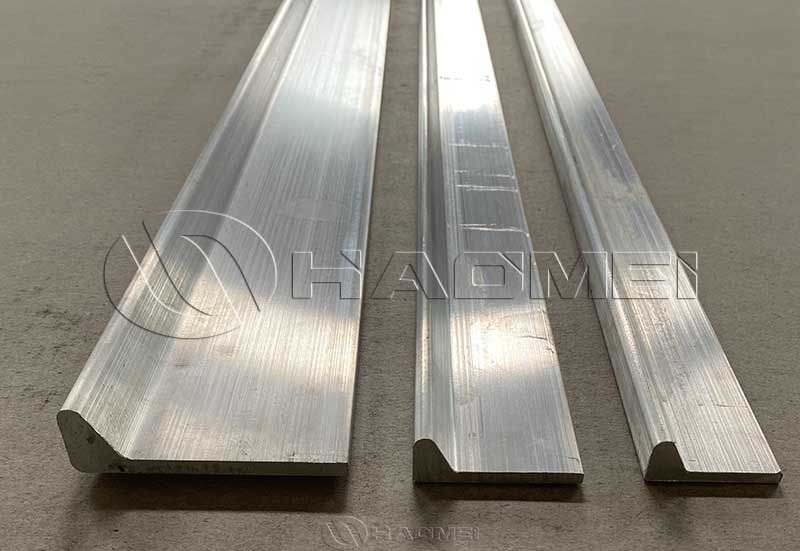
1. Hull and Deck Reinforcement
The thickness of a ship's hull is limited; even the hull of a 10,000-ton vessel is only about 15-20 millimeters thick, making it highly susceptible to deformation under the pressure of seawater and the impact of waves.
Bulb bar, acting as a "reinforcing rib" in the hull plates, is extensively welded vertically inside the hull and also used on the deck floor and sidewalls. By distributing stress, it effectively improves the overall strength and stability of the hull and deck, preventing structural deformation and ensuring safe navigation in complex marine environments.
Commonly used 5083 and 6082 series bulb flat aluminum, with their excellent corrosion resistance and high strength, are suitable for hull parts with different strength requirements. 6082 bulb flat aluminum is mainly used in structural reinforcement areas with higher strength requirements.
2. Bulkhead and Compartment Structure Construction
Bulkheads inside a ship are crucial for dividing different functional areas and ensuring the independence and safety of compartments. Bulk flat aluminum can serve as the supporting framework for bulkheads, used in conjunction with aluminum plates to construct robust bulkhead structures.
Whether in cargo holds, passenger cabins, or equipment compartments, bulb plate aluminum provides stable structural support for bulkheads, while its lightweight characteristics do not add extra weight to the hull, balancing structural strength and the ship's navigational flexibility. Furthermore, in cargo hold bulkheads and compartments, bulb flat aluminum can help distribute cargo weight, preventing damage to the bulkheads due to excessive localized stress.
3. Keel and Anti-roll Structure Manufacturing
The keel is a core component for maintaining a ship's balance and resisting wind and waves. Aluminium oblate can be used in the manufacture of bilge keels, effectively enhancing the ship's roll stability, reducing the amplitude of rolling in wind and waves, and improving navigation safety. For ships with high roll control requirements, such as passenger ships and research vessels, the application of bulb flat aluminum in bilge keels is particularly important, significantly improving the ship's sailing comfort and stability. Simultaneously, bulb flat aluminum can also be used to supplement the hull keel, further optimizing the hull's resistance to wind and waves.
Other Aluminum Profiles in Shipbuilding
Besides bulb flat aluminum, various aluminum profiles are used in shipbuilding according to different functional requirements. Among them, aluminum elbows, as the "steering core" of piping systems, are the most widely used. Other types include aluminum flat bars, aluminum tubes, and aluminum angles, each playing a role in different scenarios to jointly ensure the normal operation of the ship.
1. Aluminum Elbows
Ships have complex piping systems, including fuel lines, cooling water lines, ballast water lines, and ventilation lines. These lines need to be maneuvered and connected in multiple directions within limited space, and aluminum tube elbows are the core component that enables this function, often referred to as the "steering core" of the piping system. Their specific applications and advantages are mainly reflected in the following aspects:
In the fuel system, aluminum elbows are used to connect fuel lines in different directions, ensuring a smooth flow of fuel from the fuel tank to the engine. Because fuel is corrosive and leakage must be prevented during transport, aluminum elbows, with their excellent corrosion resistance and high-precision sealing design, perfectly meet this requirement. The high-precision forging process results in smooth, burr-free inner walls, reducing fuel flow resistance. The sealing groove design at the interface perfectly fits the sealing ring, completely eliminating the risk of fuel leakage.
In the cooling system, ship engines generate a large amount of heat during operation, requiring cooling water to be transported through cooling water pipes for cooling. These cooling water pipes must bypass the engine, generator, and other equipment, making multiple turns to complete the circulation. Aluminum elbows are available in various angle specifications, including 45°, 90°, and 135°, allowing for flexible selection based on pipeline layout. Aluminum's excellent thermal conductivity also helps cooling water pipes dissipate heat quickly, preventing localized overheating that could affect equipment operation.
2. Other Commonly Used Aluminum Profiles and Applications
Besides aluminum elbows, the following aluminum profiles are also widely used in shipbuilding, covering multiple areas such as structure, interior decoration, and auxiliary equipment:
Aluminum Flat: Divided into different series, each with its own focus. 6061 series aluminum flat strips, due to their good processing performance and surface treatment effects, are often used in ship interior decoration, such as decorative lines, window frames, and door frames, especially in luxury cruise ships, enhancing the aesthetics and comfort of the cabin. 6086 series aluminum flat strips have higher strength and can be used in small structural components on ships that bear high loads, such as connectors in transmission mechanisms, load-bearing supports, and some small frame structures with high strength requirements.
Aluminum Tubes: As a basic component of ship piping systems, they are used in conjunction with aluminum elbows to form a complete fluid transport system. Commonly used 5083 and 6061 series aluminum tubes are used for pipelines operating under different pressures and media, such as fuel lines, cooling water lines, and ventilation ducts. They are also used in the manufacture of masts, gangways, and handrails, replacing traditional steel pipes to reduce hull weight due to their lightweight and corrosion resistance.
Aluminum Angles: They are mainly used for connections and fixation in ship structures, such as the connection between bulkheads and decks, the fixing of equipment brackets, and the splicing of interior panels. Their regular shape and good weldability effectively enhance the strength of connections while avoiding sharp edges that could cause cuts, balancing practicality and safety.
In addition, aluminum rods and aluminum profile frames also play a role in shipbuilding. For example, aluminum rods are used in the manufacture of hull frames, handrails, and gangways, while aluminum profile frames are used for equipment protection and compartment partitions. These various aluminum profiles work together to form the core structural system for lightweight and corrosion-resistant ships.
Original Source:https://www.marinealu.com/a/what-are-the-uses-of-bulb-plate-in-ship.html
Tags: ball flat aluminum ,