6082 Aluminum Plate for Marine Structures
As a representative of the 6000 series (aluminum-magnesium-silicon) heat-treatable aluminum alloys, 6082 aluminum plate, with its excellent comprehensive performance—moderate to high strength, good weldability, outstanding resistance to seawater corrosion, and lightweight advantages—has become one of the indispensable core materials in modern ship structures.
Especially in the manufacture of high-speed ships, passenger ships, and special-purpose vessels, the application of 6082 aluminum plate is becoming increasingly widespread. The appropriate selection of its different heat treatment states (such as T4 and T651) is crucial to achieving the functional requirements of various parts of the ship.
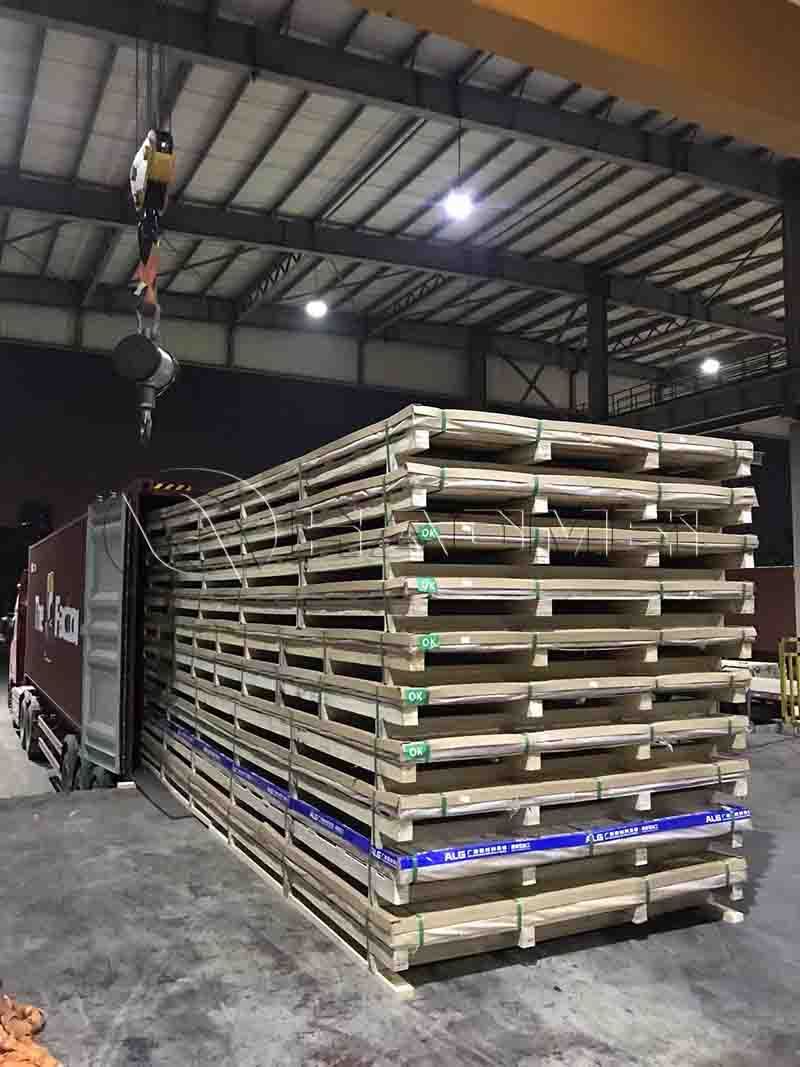
Comparison of Core Performance of Commonly Used States (T4, T651)
1. 6082-T4
The core advantages of 6082 t4 are excellent formability and toughness, while retaining a certain level of strength. Tensile strength ≥205MPa, yield strength ≥110MPa, elongation ≥14%. It is easy to perform cold working such as bending and stamping, suitable for ship components requiring complex forming. Furthermore, its weldability is stable, and structural integrity can be guaranteed without complex post-weld treatment.
2. 6082-T651
This temper is the high-strength temper of 6082 aluminum sheet, with a tensile strength ≥310MPa, yield strength ≥260MPa, hardness approximately 95HB, extremely high dimensional stability, minimal processing deformation, and good corrosion resistance and weldability. It is suitable for ship load-bearing structures and critical components with extremely high requirements for strength, rigidity, and dimensional accuracy.
In addition, H112 and O tempers of 6082 aluminum sheet are also used to a small extent, but T4 and T651 tempers are the core choices in ship structures due to their balanced performance. A reasonable combination of the two can achieve the dual goals of "lightweight + high strength," balancing ship navigation efficiency and structural safety.
Specific Applications in Various Ship Parts
(I) Superstructure
The ship's superstructure includes the bridge, deckhouse, engine room, masts, etc. These parts do not directly bear the main loads of the hull, but need to have good resistance to seawater corrosion and atmospheric corrosion, and require complex forming processes with high requirements for surface flatness.
Due to its excellent formability and toughness, the 6082-T4 temper aluminum sheet is the preferred material for this part. For example, the bridge panel, deckhouse sidewalls, and roof need to be bent and stamped into complex shapes; T4 temper aluminum sheets can be easily processed and are less prone to cracking and deformation after forming.
As a landmark component of a ship, the mast needs to possess sufficient strength and wind resistance while remaining lightweight to reduce the ship's center of gravity shift. The strength of 6082-T4 aluminum sheet meets the mast's load-bearing requirements, and its weight is only one-third that of steel, effectively reducing the ship's load. Furthermore, anodizing the aluminum sheet in this part further enhances its corrosion resistance and aesthetics, extending its service life.
(II) Main Hull Structure
The main hull structure is the "skeleton" of the ship, including the deck, bottom longitudinals, side longitudinal girder, and transverse beams. These parts directly bear core loads such as wave impact, the ship's own weight, and cargo weight, requiring extremely high strength, rigidity, and dimensional stability of the materials. Aluminium 6082 t651, with its high strength and excellent dimensional stability, has become the core material for this part.
1. Deck
As the ship's load-bearing surface, it needs extremely high resistance to pressure and impact, while also being resistant to seawater erosion and corrosion. 6082-T651 hot-rolled aluminum plate (thickness 3-50mm) is an ideal choice for the deck. Its high strength can withstand the loads of cargo stacking and personnel activity.
Its good dimensional stability makes it less prone to deformation due to temperature changes or stress; and its excellent resistance to seawater corrosion allows for long-term use in marine environments.
After welding using friction stir welding, the weld width is ≤3mm, and the sealing performance reaches a leakage rate of 0.01MPa. Replacing traditional riveting processes can achieve a weight reduction of 15%.
2. Bottom longitudinal girder and side longitudinal girder
These components are the main load-bearing structures of the hull, responsible for transmitting longitudinal loads and resisting wave impacts. 6082-T651 extruded profiles (complex cross-section, thickness 2-15mm) have high strength and excellent bending resistance, with a bending strength of 450MPa, 15% higher than 6061-T6. This effectively distributes loads, preventing hull deformation, while their lightweight characteristics reduce drag during navigation and improve fuel economy.
(III) Internal Structure of the Ship
The internal structure of a ship includes bulkheads, spacers, stairs, handrails, equipment supports, etc. These components have diverse requirements; some require complex molding, while others require a certain load-bearing capacity. Therefore, 6082-T4 and T651 profiles can be used in combination according to specific needs.
1. Bulkheads and spacers
Primarily used to divide the internal space of the ship, they need to possess certain strength and sound and heat insulation properties, while also being lightweight to reduce the overall weight of the hull.
6082-T4 aluminum sheets offer good formability, allowing for processing into various sizes. They provide a stable welded structure and are lightweight, effectively reducing the load on the hull. Their excellent corrosion resistance also prevents rust caused by the humid environment inside the cabin.
2. Staircases and Handrails
As critical components for personnel passage, staircases require sufficient strength and anti-slip properties, while also being easy to process and install. 6082-T651 aluminum sheets offer high strength and can be processed into anti-slip panels and handrail profiles.
They have strong load-bearing capacity, are not easily deformed, and their surface can be treated with an anti-slip finish to ensure personnel safety. T4 tempered aluminum sheets can be used for staircase connections, facilitating bending and forming for seamless integration with handrails and bulkheads.
3. Marine Equipment Brackets
Navigation, communication, and life-saving equipment on ships require brackets for fixation. These brackets must possess sufficient strength and stability while remaining lightweight to avoid affecting equipment operation.
6082-T651 aluminum sheets have high strength and dimensional accuracy, can be processed into customized brackets, can stably fix various equipment, and have good corrosion resistance, making them suitable for the humid environment inside ships.
(IV) Marine Auxiliary Structures
Marine auxiliary structures include gangways, railings, ventilation ducts, and marine pressure vessels. Although these are not core load-bearing components, they require materials with high corrosion resistance, formability, and lightweight properties.
For example, gangways, as passageways for personnel to board and disembark, require frequent folding and unfolding, placing extremely high demands on the toughness and formability of the materials. 6082-T4 temper aluminum plates have good toughness and are easy to bend and form, which can be processed into foldable gangway components. They are also resistant to seawater corrosion and can be used in marine environments for a long time.
As safety protection components, railings need to have a certain strength and aesthetics. T4 temper aluminum plates can be processed into various railing profiles. After welding, the structure is stable, and after anodizing, the appearance is neat and fits the overall design of the ship.
In addition, lightweight marine pressure vessels (such as air storage tanks and inert gas tanks) can also use 6082-T4 or T651 temper aluminum plates, which take into account both strength and corrosion resistance and meet pressure requirements.
Original Source:https://www.marinealu.com/a/6082-aluminum-plate-for-marine-structures.html
Tags: 6082 aluminum plate ,