What Are Involved In Aluminum Boat Building
Marine material selection prioritizes lightweight construction, resistance to seawater corrosion, ease of processing and welding, and strong adaptability. Compared to carbon steel and stainless steel, marine aluminum alloys are lighter, have better thermal conductivity, and are more resistant to salt spray corrosion, resulting in weight reduction, increased speed, and lower fuel consumption.
They are now widely used in the superstructures of various types of ships and offshore platforms. The marine aluminum boat building supplies encompasses four core categories: marine aluminum plates, marine aluminum profiles, marine aluminum pipe fittings, and marine aluminum welding wire.
I. Materials for Ship Basic Structure
1. Marine Grade Aluminum Sheet
Marine aluminum plate is the most widely used aluminum material in ships, divided into structural load-bearing plates, interior cladding plates, and corrosion-resistant plates. Mainstream grades and applications are clearly defined:
- 5083 Aluminum Plate (Industry Benchmark): H116/H321, specifically for marine applications, excellent resistance to intercrystalline corrosion, superior weldability, and strength suitable for hull shells, decks, ballast tanks, and oil storage tanks. It is the standard plate for medium and large-sized seagoing vessels.
- 5086 Aluminum Plate: Better pitting corrosion resistance than 5083, suitable for bulkheads in wave-splashed areas and near-shore high-salt-spray areas. Often used for the outer cladding of small fishing boats and sightseeing boats.
- 5052/5754 Aluminum Plate: Medium strength, high cost-effectiveness, specifically for interior walls, storage cabinets, and ventilation panels in non-load-bearing cabins.
- 6061/6082 Aluminum Sheets: Heat-treated for increased hardness, commonly used for equipment bases, reinforcing pads, and thickened plates for machinery.
2. Marine Aluminum Profiles
Custom-designed irregular sections using extrusion processes, eliminating the need for secondary cutting and processing. Suitable for standardized shipbuilding structures, eliminating welding deformation steps. Mainstream grades follow the 5-series and 6-series: 5083 extruded profiles are used for ship railings, keel reinforcement, and deck reinforcement beams; 6063 anodized profiles offer high aesthetics and wear resistance, specifically used for cabin door frames, ceiling joists, and sightseeing boat railings; 6082 high-strength profiles are used for superstructure load-bearing columns, suitable for large cruise ships and offshore platform frame construction.
II. Marine Aluminum Welding Wire
The splicing of aluminum alloy hulls and pipe fittings requires extremely high weld compatibility. Mixing ordinary aluminum welding wires can lead to weld corrosion, cracking, and pressure failure. Shipbuilding strictly matches welding wire grades to the base material:
- 5356 Aluminum Welding Wire: Most versatile, suitable for all 5052, 5083, and 5086 series marine aluminum plates and pipes. The weld is resistant to seawater corrosion, making it the first choice for routine welding of hulls and pipelines.
- 5183 Aluminum Welding Wire: Dedicated for high-strength welds, with stronger pressure resistance and crack resistance. Suitable for welding high-pressure aluminum pipes and hull load-bearing structures.
- 4047 Aluminum-Silicon Welding Wire: Good fluidity and less prone to porosity. Suitable for welding 6-series aluminum profiles and anodized aluminum materials, primarily used for splicing cabin decoration structures.
III. Marine Piping Fittings
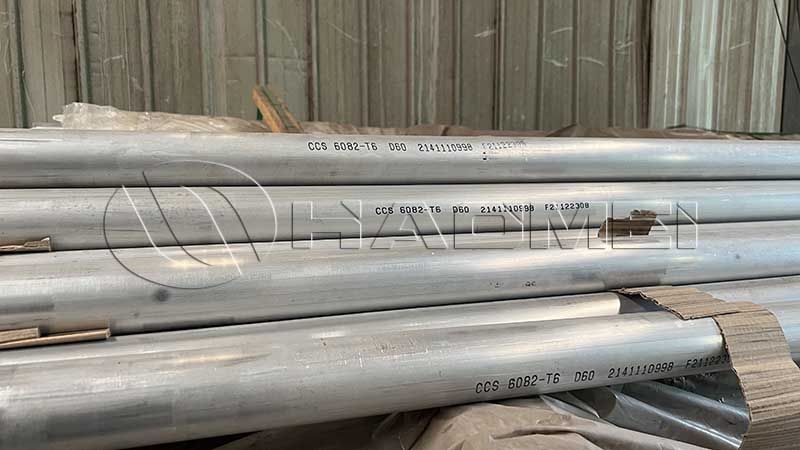
Marine grade aluminium tube cannot be used alone in a network; they must be paired with matching aluminum alloy pipe fittings to form a closed-loop piping system. To ensure consistent corrosion resistance and pressure resistance throughout the pipeline, steel fittings are strictly prohibited from being mixed with the aluminum pipes; the material must be identical to the aluminum pipe.
Main Fitting Categories: Aluminum alloy elbows, tees, reducers, flanges, pipe clamps, sealing joints, plugs; Material Classification: High-pressure piping fittings use 5083 forged aluminum alloy, low-pressure water supply and drainage piping uses 5052 aluminum alloy, and lightweight decorative piping uses 6061 aluminum alloy.
Suitable Scenarios: Marine subsea valve piping, engine room oil lines, freshwater circulation, seawater desalination, and air conditioning ventilation piping connection and fixing. All fittings are pressure-resistant and salt spray-resistant, suitable for alternating high and low temperature conditions in the ship's cabin.
IV. Marine Aluminum Pipes
1. Two Major Alloy Systems and Grade Compatibility for Marine Aluminum Pipes
(1) 5-Series Aluminum-Magnesium Seamless Aluminum Pipes
They cannot be heat-treated for strengthening, naturally resistant to seawater corrosion, excellent weldability, and used in over 80% of marine pipelines:
- 5083 Aluminum Pipe: Core high-pressure pipe material for marine applications, magnesium content 4.0%-4.9%, high pressure resistance, and stress corrosion resistant, suitable for engine room fuel lines, high-pressure hydraulic lines, subsea water intake mains, and fire-fighting high-pressure lines. Common states are H112/H116, suitable for pressure-bearing pipelines on large and medium-sized seagoing vessels;
- 5086 Aluminum Pipe: Best resistance to seawater pitting corrosion, suitable for pipelines that are submerged in seawater for extended periods and subjected to wave erosion, mostly used in seawater desalination units, external circulating water pipes, and exposed pipelines on near-shore vessels;
- 5052 Aluminum Tube: Low-pressure universal type, high cost performance, suitable for freshwater transportation in cabins, air conditioning condensate pipes, ventilation round pipes, low-pressure sewage pipes, standard equipment for small yachts and inland waterway vessels.
(2) 6-Series Aluminum-Magnesium-Silicon Extruded Aluminum Tubes
They can be heat-treated to increase hardness, strong machinability, and corrosion resistance is upgraded after anodizing. Mostly used for non-direct contact seawater pipelines and structural pipes:
- 6061 Aluminum Tube: Suitable for closed-loop water circulation in cabins, instrument control pipes, and pipeline support structural pipes. Matching 6061 aluminum fittings facilitate easy assembly and disassembly.
- 6063 Aluminum Tube: Thin-walled and lightweight, specifically used for cabin ventilation pipelines and decorative protective sleeves, with extremely low pressure requirements.
2. Core Advantages of Marine Aluminum Pipes Compared to Metal Pipes
- Weight Reduction and Efficiency Improvement: For the same pipe diameter and wall thickness, the weight is significantly lower than steel pipes, reducing hull load and ship energy consumption;
- Marine Compatibility: Naturally resistant to salt spray and seawater electrochemical corrosion, eliminating the need for frequent anti-corrosion painting and maintenance, with a service life of over 15 years;
- Convenient Construction: Easy to bend and drill, allowing for on-site welding with 5356 aluminum welding wire, and strong sealing performance when paired with matching aluminum fittings;
- Hygiene and Environmental Protection: Smooth pipe walls reduce the growth of marine microorganisms and scale buildup, making it suitable for drinking water and seawater desalination pipelines.
Original Source:https://www.marinealu.com/a/what-are-involved-in-aluminum-boat-building.html
Tags: marine grade aluminum sheet ,
Prev:5356 Filler Rod