C70600 Pipe in Naval and Commercial Shipbuilding
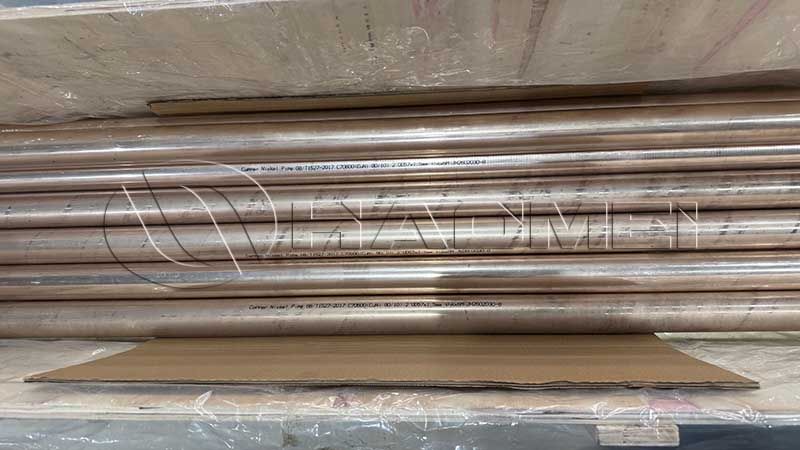
C70600 pipe is a 90/10 copper-nickel alloy pipe containing 10% nickel and trace amounts of iron and manganese. Its performance is significantly superior to conventional marine pipes such as carbon steel and ordinary stainless steel, making it suitable for various seawater conditions.
This pipe exhibits an extremely low corrosion rate in flowing seawater, only one-tenth that of carbon steel, and its surface can form a self-healing protective film, resisting water erosion and minor mechanical wear, and quickly repairing the protective layer. It also possesses excellent resistance to marine organism adhesion, effectively preventing pipe blockage and corrosion damage, meeting the long-term operational requirements of marine seawater pipelines, and is a high-quality pipeline material applicable to both military and civilian vessels.
I. Full-Scenario Adaptability
1. Seawater Cooling System
The seawater cooling system is a key cooling facility in marine propulsion systems, responsible for dissipating heat from core equipment such as main and auxiliary engines, lubrication systems, and air conditioning condensers. It continuously transports flowing seawater, placing stringent requirements on the pipe's erosion and corrosion resistance.
C70600 pipes possess excellent erosion resistance, withstanding high-speed seawater impacts and effectively preventing pipe wall wear and perforation, thus eliminating pitting and crevice corrosion caused by seawater and salt spray. Whether a ship is sailing at high speed and under heavy load, or a merchant vessel is operating on long-distance oceans, this pipe material ensures the stable operation of the cooling system, significantly reducing the risk of pipeline failure and downtime, and guaranteeing continuous power output for the vessel.
2. Marine Firefighting Piping
Marine firefighting systems are directly related to navigational safety, requiring pipelines to be readily available and leak-free upon activation. Traditional carbon steel pipes are prone to rust and scaling, and long-term idleness easily leads to blockages and leaks, posing significant safety hazards.
C70600 copper-nickel alloy pipes are rust-free and scale-free, exhibiting outstanding resistance to seawater corrosion and aging, maintaining clean and unobstructed inner walls even after long-term water storage. Simultaneously, the pipe material has good mechanical toughness, resistance to vibration and deformation, and can adapt to complex operating conditions such as hull rolling and deformation, ensuring rapid response and stable water supply in the event of a fire, making it the preferred material for marine firefighting pipelines.
3. Ballast System
The ship's ballast system regulates the hull's draft and attitude by venting seawater, ensuring smooth navigation and loading/unloading operations. This system's pipelines frequently start and stop, operating in alternating wet and dry conditions, making them prone to marine organism growth and corrosion.
Copper nickel pipes possess inherent anti-marine organism adhesion properties, inhibiting the growth of algae, shells, and microorganisms, reducing pipeline blockage at its source. Its excellent resistance to alternating wet and dry corrosion makes it suitable for the intermittent operation mode of the ballast system, ensuring long-term pipeline unobstructed flow, supporting ship attitude adjustments and merchant ship loading/unloading operations, and effectively reducing system maintenance frequency.
4. Baffle System
The bilge system is responsible for draining engine room water, leaked seawater, and oily wastewater. The water quality is complex, and the operating conditions are harsh; conventional pipelines are prone to scale buildup, corrosion, leakage, and blockage.
C70600 alloy is resistant to fouling and corrosion, and resists impurity adhesion. Its smooth inner wall prevents dirt residue buildup, effectively avoiding bilge pipeline failures. It can quickly drain water from sealed compartments of ships and engine rooms of commercial vessels, preventing dampness from corroding equipment and damaging the hull structure, thus stabilizing the ship's internal operating environment.
5. Heat Exchanger Piping
Marine heat exchangers are widely used in systems such as freshwater preparation, lubricating oil cooling, and waste heat recovery. The internal piping circulates seawater for extended periods, requiring extremely high thermal conductivity, corrosion resistance, and stability.
C70600 pipe fittings have excellent thermal conductivity and strong seawater adaptability, preventing pipe wall thickening and heat exchange efficiency reduction due to erosion and corrosion during long-term operation. Furthermore, the pipe material exhibits excellent welding and expansion process performance, meeting the needs of precision piping processing, ensuring the long-term, efficient, and stable operation of precision heat exchange equipment on ships and large heat exchange systems on commercial vessels.
II. Proven by Sea Conditions
Compared to conventional marine piping materials such as stainless steel, carbon steel, and aluminum alloys, cupronickel tube, with its comprehensive and irreplaceable properties, has become a core piping material for both military and civilian vessels. It has been proven highly reliable under various complex sea conditions.
This pipe boasts exceptional marine corrosion resistance, specifically developed for seawater conditions. It is adaptable to all marine environments, including static and flowing seawater, alternating wet and dry conditions, and high salt spray. Its annual corrosion rate is significantly lower than conventional marine steel, completely resolving common problems such as pipe perforation, leakage, and damage. It also features maintenance-free anti-biofouling properties, requiring no additional coating to maintain a clean inner wall, reducing pipeline cleaning and maintenance costs, and making it suitable for long-haul, low-maintenance vessels.
In terms of manufacturing and mechanical properties, C70600 pipe exhibits excellent flexibility, allowing for easy bending, welding, and expansion joints, adapting to the compact and complex piping layouts of ships. Furthermore, it demonstrates outstanding vibration and fatigue resistance, withstanding continuous hull vibration and minor deformation, and is less prone to weld cracking and pipe loosening, making it suitable for various complex navigation conditions on ships.
It offers significant advantages in cost-effectiveness and longevity. Compared to high-end titanium alloy pipes, it is more cost-effective, making it suitable for large-scale applications in commercial vessels; compared to ordinary steel, its service life is significantly extended, resulting in extremely low total life-cycle maintenance costs. Decades of global marine applications have proven that this pipe can be used throughout the entire service life of a ship without frequent replacements or maintenance, balancing operational safety and economic practicality.
Original Source:https://www.marinealu.com/a/c70600-pipe-in-naval-and-commercial-shipbuilding.html
Tags:
Prev:Aluminum Clad Steel
Next:ER5356 Rod