5083 H116 vs H321 Aluminum Plate
5083 aluminum plate, a long-established marine-grade rust-resistant aluminum, has become a mainstream material for civilian ships, engineering vessels, and offshore platforms due to its excellent comprehensive performance. H116 and H321 5083 plates, with different tempering states, are the two most widely used specifications in the marine industry.
Core Performance Comparison
1. 5083 H116
5083 H116 aluminum plate is a strain-hardened marine-grade aluminum. Through a specialized process, it effectively avoids stress cracking problems after aluminum alloy processing, making it a classic general-purpose marine aluminum material. In terms of mechanical properties, its tensile strength is stable at 290-350MPa, with excellent hardness, solid overall strength, and outstanding load-bearing capacity.
Regarding corrosion resistance, 5083 H116 meets the ASTM G67 intergranular corrosion test standard, possessing good resistance to seawater chloride ion corrosion and stress corrosion cracking, and can adapt to normal marine alternating wet and dry conditions.
Meanwhile, this material exhibits stable weldability, minimal strength loss after welding, and good formability. Secondary processing such as bending and cutting is less prone to cracking, balancing structural strength and ease of processing.
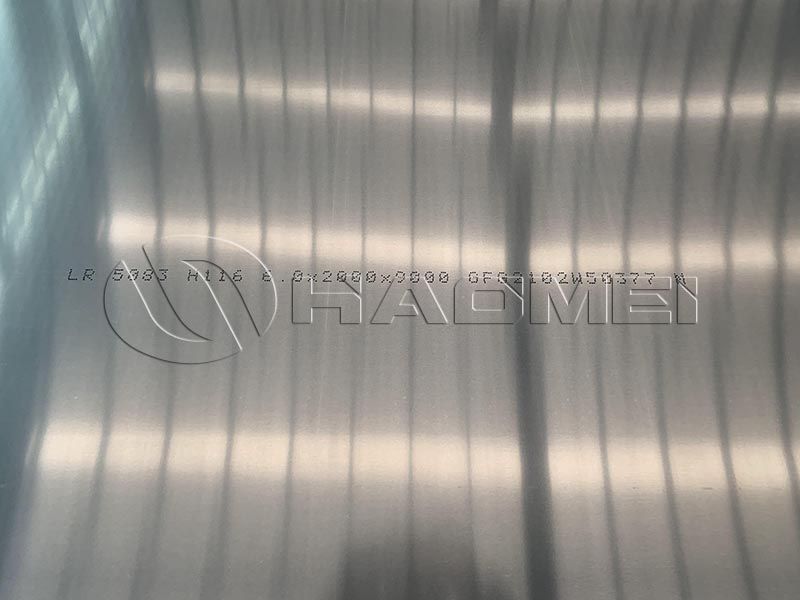
2. 5083 H321
5083 H321 is in a strain-hardened + stabilized tempered state. Based on H116, its heat treatment process has been optimized, resulting in a more uniform and stable internal microstructure. Its tensile strength ranges from 270-320 MPa, slightly lower than H116, but its plasticity, toughness, and fatigue resistance are significantly improved, allowing it to withstand long-term dynamic loads and repeated impacts.
Its core advantages lie in corrosion resistance and thermal stability. H321's overall corrosion resistance is approximately 5% higher than H116, especially in resistance to exfoliation corrosion, intergranular corrosion, and weld heat-affected zone corrosion.
In harsh marine environments characterized by high salt spray, high humidity, and prolonged immersion, 5083-H321 plates can extend their service life from 10 to 15 years. Furthermore, the welded structure is resistant to deformation and exhibits minimal performance degradation, making it a specialized material for demanding marine applications.
Core Ship Applications
1. Leveraging its advantages of high hardness, high load-bearing capacity, ease of processing, and cost-effectiveness, 5083 H116 is primarily used for core structural components in ships undergoing conventional load-bearing operations and not requiring prolonged immersion. It is a mainstay material for small and medium-sized vessels and conventional cargo ships. Specific applications include: ship decks, hull side plates, bulkheads, superstructure structures, container frames, hull stiffeners, and equipment bases.
These components primarily bear static loads under relatively mild conditions, without prolonged high-intensity dynamic impacts. H116's strength and corrosion resistance fully meet these requirements, while effectively controlling shipbuilding costs, balancing practicality and economy. It is widely applicable to fishing vessels, inland waterway vessels, general cargo ships, and small to medium-sized yachts.
2. Leveraging its superior corrosion resistance, fatigue resistance, and weldability, the 5083 H321 marine grade plate focuses on key components in ships facing high corrosion, high dynamic loads, and high reliability requirements. It is widely used in large seagoing vessels, ocean-going vessels, and marine engineering equipment.
Specifically, it includes: hull bottom plates, underwater hull structures, ballast tank inner walls, cryogenic liquid containers, LNG carrier auxiliary structures, offshore platform decks, and ship dynamic load-bearing supports.
These components are constantly immersed in seawater, subjected to chloride ion corrosion, water flow impact, and dynamic fatigue loads caused by hull rolling. This places extremely high demands on the stability and durability of the material.
Only the stable microstructure of H321 can effectively prevent corrosion aging, structural deformation, and cracking after long-term use, ensuring safety during ocean voyages and deep-sea operations.
Industry Market Demand
1. 5083- H116
Currently, the rapid pace of upgrades in inland waterway shipping, near-shore fishing, and small-to-medium-sized civilian vessels, coupled with the expanding market for leisure yachts and small workboats, has ensured stable and essential demand for 5083 H116 aluminum plates.
This material has mature manufacturing processes, low mass production costs, and stable supply, making it suitable for most conventional shipbuilding and maintenance scenarios. It is the "basic mainstay" of the marine aluminum alloy market, with large and consistently stable market demand.
2. 5083-H321
In recent years, the high-end marine equipment industry, including ocean-going freighters, large container ships, LNG carriers, offshore wind power maintenance vessels, and deep-sea engineering platforms, has developed rapidly. The industry's requirements for the durability, safety, and resistance to harsh environments of shipbuilding materials have continuously upgraded. Traditional H116 can no longer meet the long-term usage requirements of the demanding deep-sea and open-ocean operating conditions, leading to a significant increase in demand for the highly stable and corrosion-resistant 5083 H321.
Meanwhile, the trend of lightweight shipbuilding further drives the expansion of the 5083 H321 market. Compared to steel, 5083 aluminum alloy is lighter, effectively reducing fuel consumption and increasing range. The superior performance of 5083-H321 perfectly matches the core requirements of high-end ships for lightweight, long service life, and low maintenance, making it the preferred material for high-end shipbuilding companies.
Original Source:https://www.marinealu.com/a/5083-h116-vs-h321-aluminum-plate.html
Tags: 5083 aluminum plate ,