What Is The Most Widely Used Marine Structural Aluminum Alloy Worldwide
Faced with the high-salt, high-humidity, and highly corrosive marine environment, and the trend towards lightweight and energy-efficient shipbuilding, aluminum alloys, with their superior comprehensive properties, are gradually replacing traditional steel and becoming the core material for marine structures.
Among the many marine aluminum alloys, marine grade aluminium 5083, with its excellent corrosion resistance, high strength, and good processing and welding performance, has become the most widely used and consumed marine structural aluminum alloy globally.
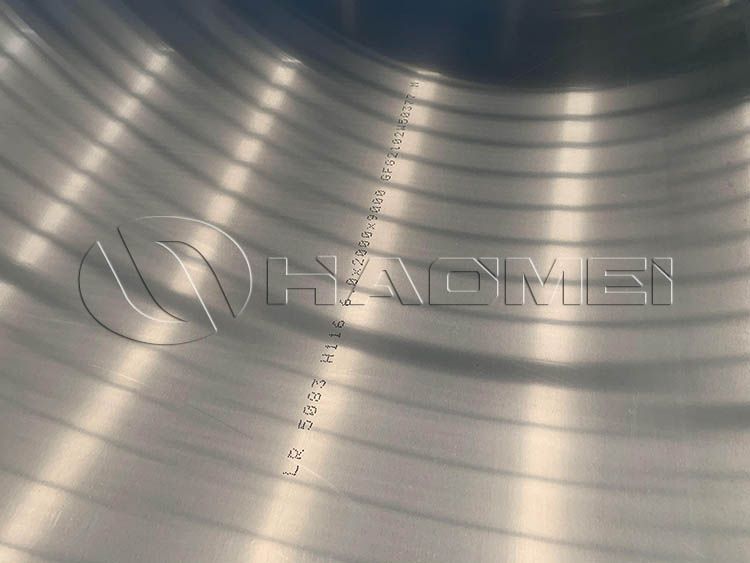
For marine aluminum alloys, the "temper" is crucial in determining their performance characteristics—through different processing and heat treatment processes, the same grade of aluminum alloy can exhibit different strengths, corrosion resistance, and stability, adapting to different structural parts of the ship.
The main marine tempers for 5083 aluminum alloy include H116, H321, H111, and H112, among which H116 and H321 are the most commonly used and representative. Although based on the same alloy base, their performance focuses differ significantly due to different processing techniques, and their applicable scenarios also differ.
1. H116 Temper
H116 is the core temper of 5083 aluminum alloy specifically designed for marine environments. Its processing technology involves "cold working strengthening only, without subsequent heat treatment," but it must pass stringent exfoliation corrosion and intergranular corrosion tests such as ASTM G66/G67 to ensure its long-term reliability in marine environments. This process design focuses its performance on "corrosion resistance" while also considering basic strength. 5083 h116 aluminum properties are as follows:
- Mechanical Properties (typical values): Tensile strength approximately 240-325 MPa, yield strength approximately 230 MPa, elongation approximately 12%, Brinell hardness approximately 83 HB. The strength level is above average, meeting the load requirements of non-heavy-loaded ship structures, while also possessing a certain degree of ductility to prevent brittle fracture under impact loads.
- Corrosion Resistance: As a core advantage of the H116 temper, its resistance to seawater corrosion is particularly outstanding. It can withstand long-term seawater immersion and salt spray erosion, and has excellent resistance to exfoliation corrosion, making it suitable for structural components that are exposed to underwater or high-humidity marine environments for extended periods. Furthermore, it exhibits excellent resistance to stress corrosion cracking, meeting the service life requirements of conventional ships without the need for additional anti-corrosion treatment.
- Machining and Weldability: It has good cold-working formability, allowing for conventional processing such as bending and shearing. However, the deformation must be strictly controlled during forming to avoid excessive deformation leading to stress concentration. It has excellent weldability with minimal weld strength loss, but welding parameters must be controlled during welding to prevent performance degradation in the heat-affected zone.
- Typical Applications: Due to its superior corrosion resistance, the H116 temper is primarily used in core load-bearing parts of ships in harsh corrosive environments, such as hull shells, deck structures, bulkheads, and bottom plating. It is also suitable for non-welded load-bearing structures on offshore platforms and the outer protective plates of LNG transport tanks.
2. H321 Temper
The processing technology for the H321 temper is "cold working strengthening + low-temperature stabilization heat treatment," meaning that after cold working, low-temperature annealing reduces residual stress within the material, optimizes the microstructure, and achieves a more balanced state between strength, stability, and machinability. 5083 h321 aluminum properties are as follows:
- Mechanical Properties (typical values): Tensile strength approximately 275-350 MPa, yield strength approximately 240 MPa, elongation approximately 13%, Brinell hardness approximately 89 HB. Compared to H116, its tensile strength and yield strength are both increased by approximately 5%, resulting in higher strength and slightly improved ductility. It can withstand greater dynamic and static loads, making it suitable for heavy-duty applications.
- Corrosion Resistance: It also possesses excellent seawater corrosion resistance. After stabilization treatment, its resistance to exfoliation corrosion and intergranular corrosion is further improved, especially in the welded area where corrosion resistance is more stable. This effectively avoids corrosion cracking caused by welding stress, making it suitable for welded structures exposed to highly corrosive environments for extended periods.
- Machinability and Weldability: This is a significant advantage of the H321 temper—the stabilization treatment reduces residual stress, resulting in superior machinability and formability. It is suitable for cold bending and deep drawing of complex structures, and exhibits good dimensional stability and resistance to deformation after forming. Simultaneously, its weldability is superior to H116, producing high-strength and tough welds, making it suitable for manufacturing complex welded structures in ships.
- Typical Applications: Due to its high strength and stability, the H321 temper is primarily used in heavily loaded parts and complex welded structures of ships, such as heavy-duty decks, icebreaker decks, ship keels, drilling modules for offshore platforms, and load-bearing structures in living quarters. It is also suitable for ship components that frequently bear dynamic loads (such as ship crane bases).
Original Source:https://www.marinealu.com/a/what-is-the-most-widely-used-marine-structural-aluminum-alloy-worldwide.html
Tags: marine grade aluminium 5083 ,