What Is Aluminum Clad Stainless Steel in Shipbuilding
In the shipbuilding industry, steel-aluminum composite panels, with their dual advantages of "steel's load-bearing capacity and aluminum's weight reduction and corrosion resistance," have become a core material connecting the main hull structure and superstructure, and are widely used in critical areas such as decks, bridges, and cabins.
Core Specifications of Steel-Aluminum Composite Panels for Shipbuilding
1. Material Specifications
The steel in aluminium steel clad sheet for shipbuilding is not necessarily stainless steel. Instead, different types of steel are selected as the base material based on the stress requirements and corrosive environment of the application area, with aluminum as the cladding. The two are metallurgically bonded through processes such as explosive bonding and hot rolling to ensure the connection strength meets standards.
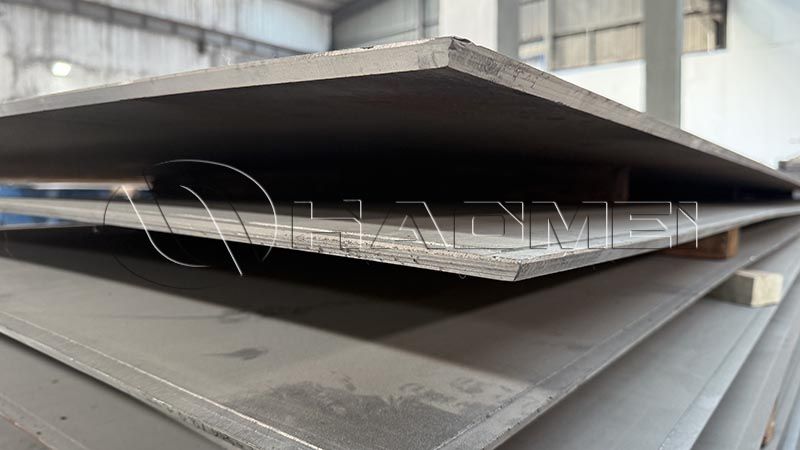
From a practical application perspective, the material combinations of steel-aluminum composite panels for marine applications mainly fall into two categories:
Firstly, non-stainless steel base material combinations: For most conventional ships, the main hull structure, decks, and other load-bearing parts use ordinary high-strength carbon steel or marine-specific structural steel, such as Q235, Q345R, DH36, and CCSB. These steels provide sufficient structural strength to meet the hull's load-bearing and impact resistance requirements.
The cladding uses marine-grade aluminum sheets such as 1050, 1060, and 5083, utilizing the corrosion-resistant properties of aluminum to isolate the steel from seawater and salt spray corrosion, extending the hull's service life.
Secondly, stainless steel base material combinations: Stainless steel is only used as the base material in special parts of ships, such as cargo tanks, seawater cooling system pipes, and key components of high-end ships. Common types include 304, 316L stainless steel, and duplex stainless steel. These types of components require extremely high resistance to corrosion and erosion. Stainless steel substrates are better suited to extreme marine environments.
For example, the mass-produced S30408 marine stainless steel plate is specifically used in the manufacture of key components for the Pinglu Canal demonstration vessel, maintaining stable performance even in extremely low temperatures and high salt spray environments.
The selection of aluminum cladding also follows clear standards, prioritizing aluminum alloys with good seawater corrosion resistance and weldability. Besides the aforementioned 1050 and 1060 pure aluminum, aluminum alloys such as 5083 are also widely used in the cladding of steel-aluminum composite plates for marine applications due to their excellent resistance to intergranular corrosion and weldability, adapting to different ship usage scenarios.
2. Dimensions and Specifications
There are no uniform, fixed standards for the dimensions of aluminium clad steel plates used in shipbuilding. Production is largely customized based on the type of vessel (cargo ship, passenger ship, yacht, etc.) and the dimensional requirements of the parts used. Key dimensional parameters are as follows:
Thickness: The overall thickness ranges widely, typically between 3mm and 120mm. The base material (steel) accounts for a larger proportion of the thickness, generally 2mm-80mm, while the cladding (aluminum) thickness ranges from 0.1mm to 20mm. For example, in composite panels used in load-bearing parts of the hull, the steel thickness can reach 6mm-80mm, and the aluminum thickness 2mm-5mm, balancing strength and lightweight. In composite panels used in the superstructure, the aluminum thickness can be reduced to 1mm-3mm, further lowering the ship's center of gravity and improving navigational stability.
Length and Width: Standard sizes are 2000mm × 6000mm. Wider and longer plates can be customized for special needs. Some manufacturers can provide smaller sizes (width less than 1000mm, length less than 4000mm) to suit the installation requirements of different parts of the ship. Pre-cutting and pre-processing are also supported, reducing on-site construction steps in the shipyard and improving shipbuilding efficiency.
3. Standards and Process Specifications
Steel-aluminum composite plates for marine applications must comply with strict industry standards, commonly including Q/XB 1906-94, CB 1343-1998, and GB/T 8546-2007. They must also pass certifications from classification societies such as CCS and BV to ensure quality meets the stringent requirements of shipbuilding.
The primary manufacturing process is explosive bonding, which achieves a seamless metallurgical bond between steel and aluminum. This results in high joint strength, capable of withstanding various stresses generated during ship navigation and preventing delamination and detachment. Hot-rolling bonding is also used for some lightweight components, balancing processing efficiency and connection stability. Both processes effectively avoid galvanic corrosion caused by direct steel-aluminum bonding, extending the lifespan of the panels from the source.
Steel-Aluminum Composite Panels for Marine Use vs. for Kitchenware
1. Different Core Requirements
Marine steel-aluminum composite panels focus on load-bearing capacity, impact resistance, marine corrosion resistance and lightweighting, to withstand wave impacts, seawater erosion, reduce hull weight and adapt to modular shipbuilding, with extremely stringent strength and corrosion resistance requirements.
Kitchenware panels prioritize uniform thermal conductivity, non-toxicity, easy cleaning and wear resistance, to ensure even heating and food safety. Their corrosion resistance only targets kitchen fumes and acidic/alkaline seasonings, far lower than marine requirements, and no high-intensity load-bearing is needed.
2. Different Material Selection
Marine panels use high-strength carbon steel/marine structural steel as the steel base (stainless steel for special areas) and marine-grade corrosion-resistant aluminum alloy, with material combinations certified by classification societies.
Kitchenware panels adopt 304/316 stainless steel as the steel base (for non-toxicity and easy cleaning) and thin pure aluminum/ordinary aluminum alloy (0.5mm-3mm) for heat conduction, mostly in a "stainless steel-aluminum-stainless steel" three-layer structure.
3. Differences in Specifications and Manufacturing Processes
Size: Marine panels are large and customized (thickness up to 120mm, length/width over 6000mm) for hull components; kitchenware panels are small and standardized (wok diameter 30cm-36cm, thickness 2mm-5mm).
Manufacturing: Marine panels use explosive bonding for strong steel-aluminum bonding and anti-delamination; kitchenware panels adopt simpler hot-rolled/cold-rolled bonding, focusing on fit and thermal conductivity.
4. Different Performance Requirements
Marine panels require high tensile strength, impact toughness and seawater corrosion resistance (corrosion rate ≤ 1/10 of pure steel), pass salt spray/impact tests, have good weldability and extreme temperature adaptability, extending maintenance cycles to 5-8 years.
Kitchenware panels need high thermal conductivity, non-toxicity, scratch resistance and easy cleaning, with low weldability requirements, meeting food contact material standards without classification society certification.
Original Source:https://www.marinealu.com/a/what-is-aluminum-clad-stainless-steel-in-shipbuilding.html
Tags: marine grade aluminum sheet ,