How to Choose Filler Wire for Boat Aluminum Welding
The selection of boat aluminium alloys must consider the highly corrosive marine environment and the high strength requirements of the hull structure. The mainstream grades are concentrated in the 5000 series (aluminum-magnesium alloy) and the 6000 series (aluminum-magnesium-silicon alloy). Different grades have significantly different characteristics and application scenarios, which is the core basis for subsequent welding wire selection.
1. 5000 Series Aluminum-Magnesium Alloys
This series uses magnesium as the main alloying element, possessing excellent seawater corrosion resistance, good weldability, and moderate strength. It is currently the most widely used category of marine aluminum alloys. Core grades include 5083, 5052, and 5086.
- 5083 Aluminum Alloy: With a magnesium content between 4.0% and 4.9%, its tensile strength can reach 275-310 MPa. It has excellent seawater corrosion resistance and excellent weld crack resistance. It is mainly used in critical load-bearing parts of marine vessels such as decks, sides, bottom plating, and engine mounts.
- 5052 Aluminum Alloy: It has better formability and fatigue strength, and its seawater resistance is also excellent. Relatively low cost, suitable for small vessels such as inland waterway ships, fishing boats, and sightseeing boats, as well as non-core load-bearing components such as the superstructure, portholes, and gangways.
- 5086 Aluminum Alloy: Its strength and corrosion resistance are superior to 5052, and it has strong electrical conductivity, making it particularly suitable for highly corrosive environments. It is mainly used in marine fuel systems, seawater storage tanks, pressure vessels, and other parts requiring extremely high corrosion resistance. It can also be used in structures bearing significant stress, such as the hull and stern plate.
2. 6000 Series Aluminum-Magnesium-Silicon Alloy
This series uses magnesium and silicon as the main alloying elements. It is a heat-treatable alloy with stable mechanical properties and good machinability, but its corrosion resistance is slightly inferior to the 5000 series, requiring surface treatments such as anodizing to improve its protective properties. The mainstream grades are 6061 and 6063, mainly used for marine fittings, hardware, instrument brackets, masts, and other components that do not directly contact seawater.
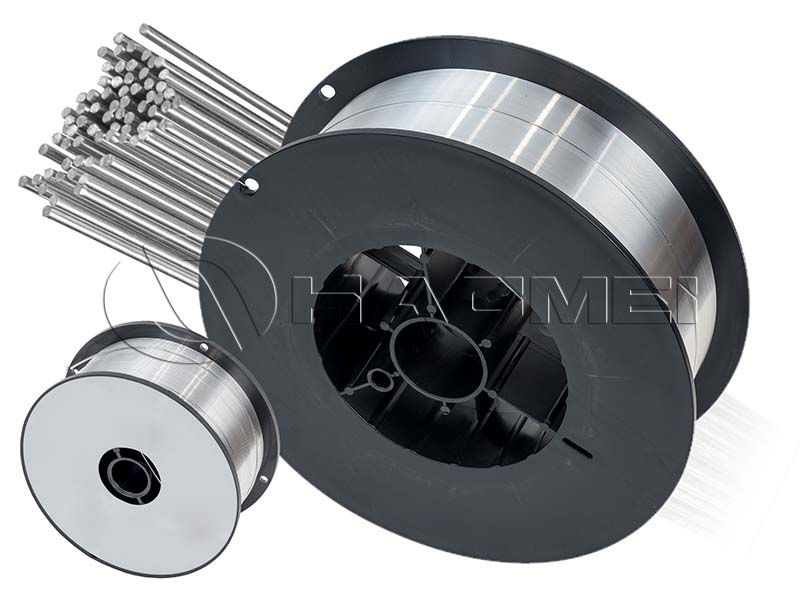
How to Choose Aluminum Welding Wire
The core of selecting filler wire for aluminium welding is "composition matching and performance adaptation." Prioritize wires from the same series as the base metal to ensure consistent weld strength and corrosion resistance. Commonly used marine aluminum welding wires are mainly divided into aluminum-magnesium series (5xxx series) and aluminum-silicon series (4xxx series), with clearly defined application scenarios for each series.
1. Aluminum-Magnesium Series Welding Wires (ER5356, ER5183)
The composition of aluminum-magnesium series welding wires is similar to that of 5000 series aluminum alloys. Their corrosion resistance and strength are highly compatible with the base metal, making them the first choice for welding 5000 series aluminum alloys, especially suitable for marine environments.
- ER5356 welding wire: Contains 4.5%-5.5% magnesium, with a weld tensile strength up to 290MPa, elongation of approximately 15%, strong resistance to deformation, and excellent seawater corrosion resistance. Compatible with almost all 5000 series aluminum alloys, such as welding 5083 ship hull structures, 5052 ship components, and 5086 storage tanks, it is one of the most widely used welding wires in marine welding.
- ER5183 welding wire: With a higher magnesium content (4.3%-5.2%) and added trace elements such as titanium and chromium, its salt spray corrosion resistance is more than 30% higher than ordinary aluminum welding wire, and the weld strength can reach 85%-90% of the base metal. Suitable for welding high-strength marine aluminum alloys such as 5083 and 5454, it is commonly used in critical structures of large marine vessels and LNG carriers where welding quality requirements are extremely high.
2. Aluminum-silicon welding wire (ER4043, ER4047)
Aluminum-silicon welding wire has a low melting point, good fluidity, and strong resistance to hot cracking, effectively solving the hot cracking problem during welding of 6000 series aluminum alloys, making it an ideal choice for welding this series of aluminum alloys.
- ER4043 welding wire: Silicon content 4.5%-6%, melting point approximately 580℃, 60℃ lower than pure aluminum, resulting in good molten pool fluidity and aesthetically pleasing weld formation. Primarily used for welding 6000 series aluminum alloys such as 6061 and 6063, and can also be used for dissimilar welding of 5000 series and 6000 series aluminum alloys. Note that this welding wire has slightly lower corrosion resistance and is not suitable for direct contact with seawater.
- ER4047 welding wire: Silicon content increased to 11%-13%, providing stronger resistance to hot cracking. Suitable for welding thicker 6000 series aluminum alloy components, or for filler transitions in dissimilar aluminum alloy welding, such as the connection between 5052 and 6061.
Purchase and Usage Guidelines
1. Look for classification society certification
Marine materials must meet strict industry standards. When selecting welding wire, prioritize products with CCS (China Classification Society) and BV (Detnis & Crédit Veritas) certifications to ensure quality compliance.
2. Pay attention to the matching of welding wire diameter and welding process
MIG welding (Gargon arc welding) commonly uses welding wire with a diameter of 1.2-1.6mm, suitable for high-efficiency welding scenarios such as hull section welding and deck splicing; TIG welding (Tungsten arc welding) commonly uses welding wire with a diameter of 2.0-3.2mm, suitable for precision welding of 3-12mm thick aluminum plates, such as ship superstructures and cryogenic pipelines.
3. Emphasize welding wire storage and pre-welding treatment
Aluminum welding wire is easily oxidized and should be used within 48 hours after opening. Unused wire should be sealed and stored in a dry box (humidity ≤60%). Before welding, the oxide film on the surface of the welding wire and base material should be cleaned by mechanical grinding and degreasing to avoid impurities causing porosity and crack defects.
4. Control the welding environment
The ambient humidity should be ≤70% and the dew point ≤-40℃ during welding; windproof measures should be taken when there is a strong sea breeze to prevent the shielding gas from failing and affecting the weld quality.
Original Source:https://www.marinealu.com/a/how-to-choose-filler-wire-for-boat-aluminum-welding.html
Tags: aluminum welding wire ,